Plenity was an FDA-cleared weight management device to help people feel fuller so they eat less. Knowing that losing weight goes beyond physical hunger, however, the makers of Plenity wanted to create a digital “member experience” to accompany a customer’s prescription. They turned to my team at Hero Digital to develop this content journey and help prescribed members build healthy behaviors for the long term.
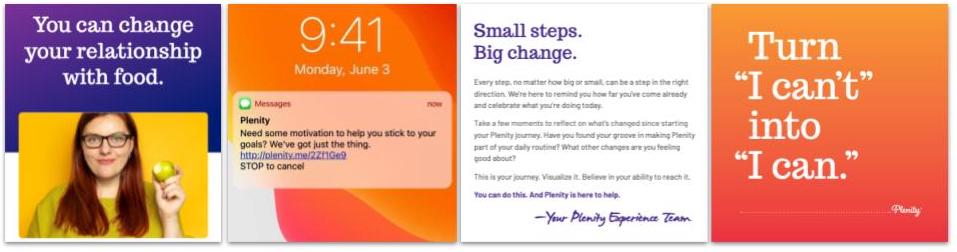
The member experience started as an email and SMS journey connecting members with informational articles, videos, and interactive landing pages to set goals or download resources. We gathered data from an initial batch of a few hundred beta members (“Group A”) to optimize the content journey, improve onboarding, and add personalization for a member base of ~6,000 people (“Group B”).
As the only full-time copywriter/content strategist for the first year of the engagement, my fingerprint is on almost every part of both the Group A and Group B journeys.
- All writing for Group A email, SMS, and print copy
- Content strategy and planning for Group B, including interpreting user research and engagement data, identifying content gaps, and developing communication journeys from onboarding to personalization to retention paths—then crafting all Group B email, SMS, landing page, and print copy, drawing from learnings from Group A performance
- Planning, copywriting, and collaboration with designers on top- and middle-of-funnel acquisition content such as MyPlenity.com site copy and prospect nurture email paths
- Leading strategy, cadence, art direction, and copywriting production of social media content, including public Facebook and Instagram posts, private member Facebook group content, and brand video
- Led client-facing meetings to review strategy recommendations, journey maps, and final creative assets
Working within limitations
Plenity was the first product released from its biotech manufacturers, and the engagement was not immune to the typical challenges of working with a startup: extreme speed, constantly changing circumstances, and limited institutional history about what works and what doesn’t for the brand in the marketplace. No other pharmaceutical brand has developed the type of member experience we set out to launch—likely due to the many challenges of creating and distributing content in such a highly regulated industry. While Plenity was classified as a device, not a drug, our risk-averse clients aimed for the stronger messaging limitations and stringency that drug brands require.
Some of the ways I managed to work within these limitations included:
- Adopting a “discovery” mindset with the client to identify messaging goals and limitations, not just as an isolated discovery phase upfront but ongoing as new considerations arose
- Softening language (turning “this has ABC impact” into “this can help you build the skills to achieve XYZ”; using “try this” rather than “do this”)
- Repurposing approved assets across channels (e.g. reusing approved copy from the FAQ page for an FAQ series on social media, long form articles becoming “pro tip” email component)
- Identifying and creating Voice of Customer opportunities; quotes and anecdotes could provide a narrative that the brand’s core claims couldn’t
- Attributing “soft” positive outcomes (e.g. increased confidence) to weight loss, rather than to Plenity
- A/B testing when possible, and being open to revision always!
Internally, process challenges and resourcing also created complications. Lacking a UX designer on the team, I took on many journey mapping and research responsibilities in addition to copywriting and content planning, as noted above.
Results
Product retention rate was 5.5% higher on average for customers who opted in to the member experience. While this correlation has confounding factors, it does demonstrate tangible business impact of the member experience.
The 4-week email onboarding journey for all members saw average open rates of 33% and click-to-open rates of 20%, compared to healthcare industry benchmarks of 22% and 10% respectively.
Personalization journeys were also successful in deepening members’ relationship with Plenity. SMS messages saw a 55% higher clickthrough rate when on a personalized journey. For email, personalized messages had 2x higher open rate, 3.2x higher unique clickthrough rate, and 1.5x click-to-open rate when compared to the baseline non-personalized journey.
The rewritten and redesigned MyPlenity.com homepage increased qualified conversions by almost 1%, and the launch of a net new Plenity Stories page boosted site pages/session by 16%, time on site by 109%, sessions/user by 92%, and most importantly, clicks to enter the prescription buyflow by 226%.
Samples (click to open PDFs)
Web: Revamped MyPlenity.com Homepage
Email: Ritual Refresh Mini-Series Kickoff
Print: Initial Shipment Package Insert