Leaving the Classroom and Learning from the World

There comes a time (namely, graduation day) when even the most academically driven students have to leave school behind and enter the proverbial “real world.”

The challenge here–especially for those who thrived in the classroom–is finding ways to continue learning. Learning shouldn’t stop just because we’ve earned a degree, but it may look a little bit different than listening to a professor’s lecture or making study guides from textbook material.

18595630_10212727916414821_4600602413980683980_oFor me, I’ve committed to learning about other histories and cultures by traveling the world for roughly 8 months post-grad. I’ll be visiting places that are both very much within my comfort zone (like Paris, a city I’ve already visited where I’ll be staying with friend from high school) and places that make me feel a bit nervous (like Morocco, where I don’t speak the language and I’ve been told it’s ideal to have a man accompanying you at all times).

Some of the learning I anticipate will come from museums that explain a country’s history thoroughly and chronologically, but I also aim to meet locals who can help to illustrate their country’s culture and customs while comparing them to the norms I’ve grown up with.

Travel is one of the most incredible ways to learn, and I’m excited to continue growing a global understanding by exploring the world. I’ll be documenting the journey primarily on my travel blog but I may include posts here to supplement.

Come along with me–you may even learn something too 🙂

Why Work-Life Balance is Crucial

“Work-life balance isn’t a teeter-totter. It doesn’t have to be 50-50. It can be 60-40 if you really value your career, or 40-60 if you’re focused on family, but you need to have a work-life balance.”

The words of the Women in Business panelist resonated with me deeply. I cringe when I hear public relations professionals talk about having to be reachable at every moment. I stress when I see completely full calendars.

We need our hobbies. Becoming a “well-rounded individual” isn’t a goal reserved for liberal arts colleges.

I hate that the answer to the small-talk “What do you do?” is your career. We are not our job descriptions.

When we’re all work and no play, we’re dull boys and girls. That phrase exists for a reason.

Instead of seeing hobbies as distractions to work, let’s see them as fuel for it.

When’s the last time you saw an aspiring entrepreneur dedicate his whole life to the desk job that pays the bills? A successful, creative entrepreneur engages her outside passions and dreams; they spark her business goals and results.

If I hadn’t let myself pursue an outside interest in writing, I wouldn’t have realized that speech-language pathology was wrong for me. I wouldn’t have realized that my true love was in communications.

Writing was my outlet, and I made it my work, so I’m using other activities to prevent burnout.

I devote a few hours each week to my college’s chapter of a service organization called Project Sunshine. And while it isn’t exactly helping my career, it gives me a dedicated time to tune out social media strategy and communications consulting. We knit, listen to throwback jams from the 2000s, and socialize with people that we aren’t competing with for jobs. We gripe about our roommates and collectively take silly BuzzFeed quizzes. We relax.

Here’s the thing:

We must refuse to make work our everything.

We must engage our outside passions.

We must be more than our job descriptions.

We must not be dull boys.

How to Use Emoji in Marketing (As Told by a Millennial)

You know the power of harnessing trends to connect your company with the younger generation, but it’s also easy to miss the mark and come across as out of touch.

Want to reduce that risk? Take these key do’s and don’ts from a millennial (ahem, me) when using emoji in your marketing efforts:

1. DO use emoji sparingly.

Using too many emoji is confusing and seems like an aggressive attempt to reach an audience you don’t understand. Carefully choosing one or two images to accent a written message is much more effective for getting the point across, especially in a PSA.

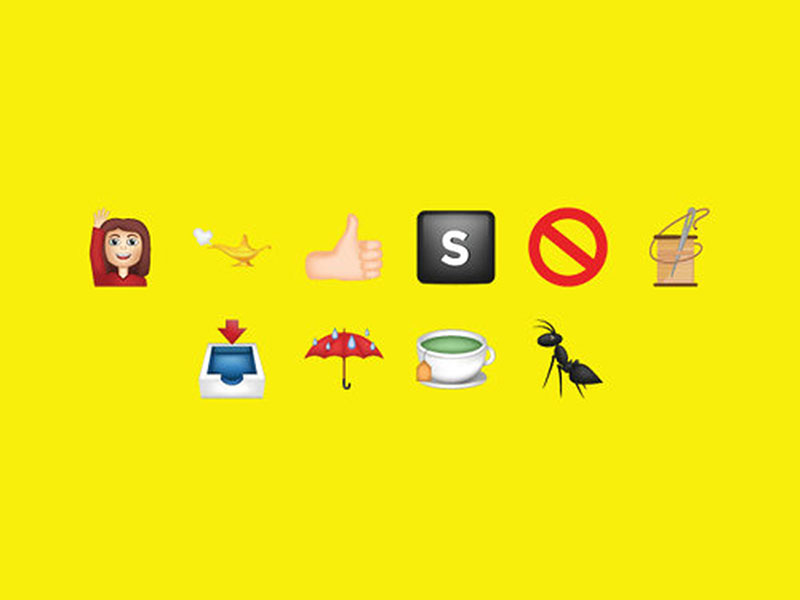
This Partnership for a Drug-Free America PSA has way too much going on. I read this image as “raising hand genie bottle thumbs up, s, no, sew (so) inbox umbrella tea ant.”

Even when I subsitute things like “raising hand” for “hey” or “genie bottle” for “wish,” I’m still entirely unsure what the organization means. And what’s the point of that?

In contrast, the VW Don’t Text and Drive campaign is simple, powerful, relevant, and gets the point across in a way that also matches their branding. Very successful.

 2. DON’T be condescending.

Believe it or not, our primary form of communication isn’t emoji—which is probably why I can’t decipher the Partnership for a Drug-Free America PSA.

Our parents love to believe we do nothing but text each other “hey, what’s up?” “not much” all day long, but we actually have real conversations using real words—augmented, not replaced, by visuals.

Don’t treat us as if our constant textual communication makes us stupid, petty, or frivolous. And definitely don’t use emoji as a subtle criticism about our tech addictions.

I’m looking at you, Pepsi. This selfie emoji bottle feels like a jab, and a personal one at that.

3. DO make sure you’re using emojis like we do.

I’ll admit it: this is the hardest part. It requires careful observation and research, including looking at how other companies are incorporating them into their communication.

But it’s also the most important part.

We love the heart eyes emoji and the tears of joy emoji (although we use it to mean “laughing so hard we’re crying”). Both of those translate easily enough, but one of the reasons emoji are so popular is that their meanings are contextually flexible.

I use the OK hand sign for both “okay” and a sarcastic “cool” (i.e. “this sucks”). Emoji cover for text’s pitfalls and allow for inflection—including sarcasm.

If you use emojis too literally, it’s a dead giveaway that you don’t speak our language. Don’t be like the companies that don’t understand that “Netflix and chill” is slang for sex.

Certain hashtags (#ShareaCoke, #Oscars, #SB50, #IWD2016) unlock branded emoji that appear automatically in the tweet. This move encourages conversation around a brand by giving a mini-incentive—the branded emoji is fun and feels official and exclusive.

But since you can’t force people to engage with your brand on social media, the hashtag needs to be part of something bigger.

JC Penney has been all over my social media with their new “Get your Penney’s worth” campaign. The company has a branded emoji that appears when you tweet with #SoWorthIt, but that’s not their entire strategy. It includes print and TV ads and an interactive digital scratch-off ad. JCP is also shifting their store layouts to make shopping easier and featuring models who “look like real people” in their commercials.

The emoji is cool, but only in conjunction with an integrated plan to make Penney’s more modern.

5. DO be creative.

I know, I know, I was just criticizing Pepsi for making fun of millennials. In fact, I did a mini-Twitter rant about it when I first heard about their new Pepsimoji campaign.

But let’s be real—Pepsi had to do something to compete with the extremely successful Share a Coke campaign, and this is a smart approach. Customization is hot right now, and Pepsi’s marketing is absolutely in line with that trend.

With a name like Sabina, I never got to be on a Coke can. But I can envision myself sending Snapchats of a Pepsi bottle with the side smirk emoji on it—just like people would take photos of their names on Coke cans or buy a bottle for a friend with the name on the label.

Using emoji can be hit or miss–some ads feel right on target and appeal to me as a millennial, while others are about as cringey as seeing someone’s grandma start an unrelated conversation in the Facebook comments of a photo they’re tagged in.

As with any strategy, using emoji is about knowing your audience, considering your goals, and integrating all your tactics into a cohesive campaign.

*peace sign hand emoji*

Who Do You Know Here?

You’ll get asked this at the door of any college house party, unless the student-turned-bouncer already recognizes you.

They always growl the phrase; “who do you know here?” becomes aggressive rather than inquisitive.

And with good reason–if you don’t know someone there, you’re more likely to steal, break something, or be an otherwise disrespectful party guest. The appointed temporary bouncer trusts those who know the house’s residents and denies those who don’t.

This is why networking is important. We tend to trust people who know our friends because we trust our friends’ judgement, and that tendency is a powerful one.

An interviewer won’t growl “who do you know here?” when you enter the company’s building, but telling them about your connections can definitely help build a positive first impression and preliminary trust.

The interviewer isn’t as worried about you breaking and stealing things, but they are concerned with your work ethic, the quality of your projects, and how you fit with company culture.

Knowing someone there implies you match their work ethic, quality, and fit.

If networking seems intimidating, it might help to think of it as your future ticket into a (professional) house party. It’s just like college all over again.

Why I Write Down ALL My Ideas

“I don’t know what I’d do if I ever lost my notebook,” I told him.

“I have a friend who writes in the same journal all year, and then burns it on New Year’s Eve,” he responded. “She says there’s always more ideas out there, and she doesn’t need the old ones. I love that.”

 I cringed. I didn’t love that.

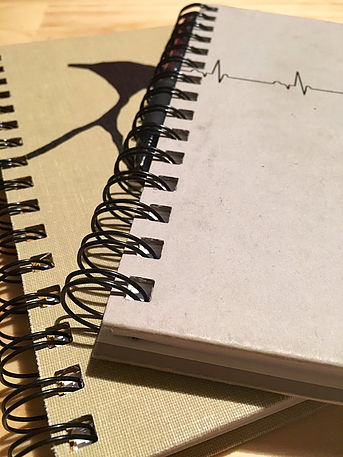
In this photo there are two spiral notebooks--one with a heart monitor reading on the cover, another decorated with a penguin illustration.What I do love is flipping through my notebook and remembering the strange (and often incredible) ideas I’ve scribbled at a poetry reading or in the dark at 4am.

I can’t stand losing even a paragraph to a technological glitch, let alone tossing everything I’d written in a year into the abyss. That gives me the chills—both in the horror movie, hair-standing-on-end way, and in the “whoa, that’s amazing” way.

Little inspiration particles constantly force their way into my head and bounce off the inside of my skull. I collect them and write them down because there’s simply no other way to prevent my brain from exploding.

But because ideas just happen to me—I don’t often brainstorm or search for aha moments—I know I can’t depend on the existence of future muses.

Tomorrow I could wake up to radio silence, not even the dull white noise of lackluster, average words. I could wake up to complete tranquility and never have another skull-rattling spark of revelation ever again.

If that happened, I’d still have my notebooks. I’d have the energy of curious word combinations to excite the inspiration particles, and I’d be back to creating.

I hope the ideas never stop infiltrating my head, but in the mean time, I think I’ll stand far away from the fire.

It’s Time To Do What You Love

 It starts when you wake up in the morning dreading your classes. Once you drag yourself there, you constantly check the clock. How could five minutes really be so long?

You look around at your classmates with disgust. They’re too competitive, too passionate about this field, too singularly focused. Why are they so obsessed? Why do they like it so much when you’re just going through the motions?

You take notes from PowerPoint slides, cram test material into your brain that you forget immediately after the exam, and can’t shake the notion that it’s pointless—you can’t actually do anything in this field until you go to grad school. These are all just prerequisite obstacles, the qualifying round for the real championship.

You deliberately chose to pursue speech-language pathology in school settings so that you can have the summers off to spend time on your real passions: writing and photography.

People scoff at the idea of being a professional writer.

They sarcastically retort, “Ha! Good luck.”

“That’s not a career!”

“You won’t make any money.”

“Better find a husband with a real job who supports that dream.”

You internalize that, so you choose a route that allows you to work with words all day, even if not in the way you’d prefer.

And then one day someone tells you that you’re too good of a writer to be a speech pathologist. Your resume and is entirely communications-related except for that one line: “Bachelor of Science in Speech-Language Pathology, expected May 2017.”

In this photo, I hold up the change of major form that the department chair signed, allowing me to pursue my real passion.

And you decide it’s time. Time to stop dreading everything. Time to choose a major that lets you do what you love every single day, not just during the summer months.

You meet with the department chair. “Have you taken any strategic communications classes?” he asks.

“No,” you say.

“How do you know you’re going to like this major, then?”

“I will, I promise.”

He signs the change-of-major form.

You leave his office feeling excited for the first time in months. You smile through your final weeks of your speech classes, knowing you’ll never have to learn about language disorders ever again.

 And you smile through the initial weeks of your graphic design class and your systems thinking class and even your intro to business class, knowing it’s exactly where you should be.

Design a site like this with WordPress.com
Get started